The Turks and Caicos National Costume
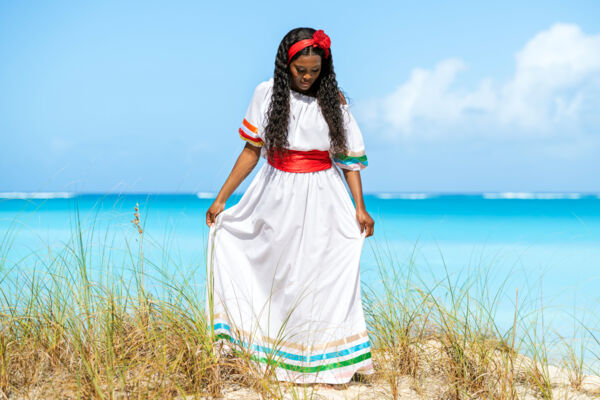
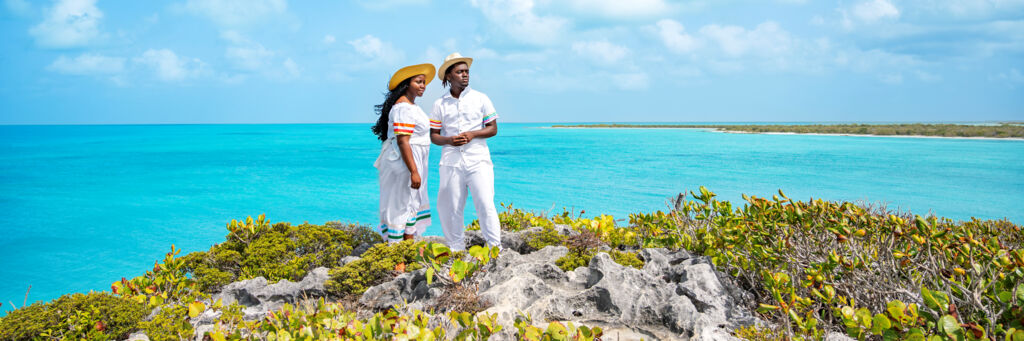
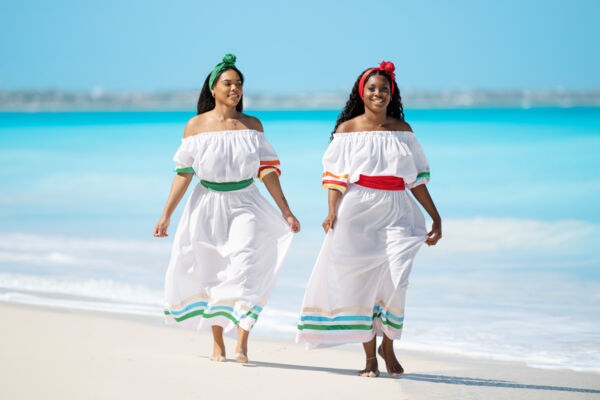
The Turks and Caicos national costume consists of a simple white cotton ensemble—a dress for women and a short-sleeved button-up shirt and long pants for men—with eight bands of color that represent the country’s major islands and various symbols and industries. Also part of the costume is a straw hat for men and a headband or headscarf for women.
It was designed and created by the Turks and Caicos Islands' former Director of Culture David Bowen and debuted in 2002 at the Queen's Golden Jubilee in Grand Turk.
The national costume is rarely worn in public and was principally designed for use at cultural events. It is different from the elaborate costumes worn by Junkanoo bands.
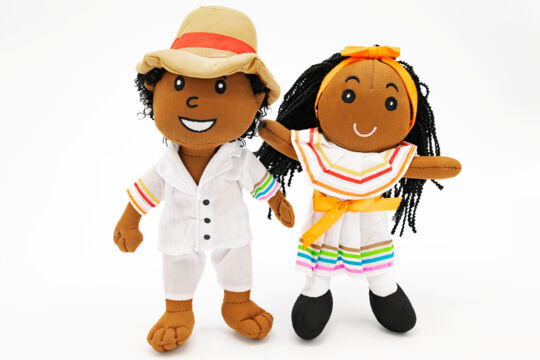
Dolls and figurines wearing the national dress are sold in many gift shops.
National Costume Colors
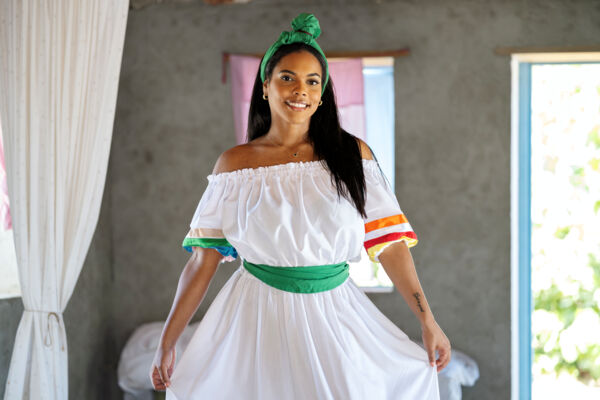
There are eight colors in the national dress, and there is a specific order in which the bands of color appear on a costume from top to bottom.
These are split into two groups: yellow, red, white, and orange, and tan, green, turquoise, and pink.
The color of the sash, headscarf, or fabric band on the straw hat depends on the home of the wearer (for example, a person from Salt Cay would have a white sash and a white headscarf or a white band of fabric on their hat).
Six of the colors represent islands, whereas two others represent national symbols (the sun and the Queen Conch and Caribbean Flamingo).
| National Costume Colors and Meanings | ||
| Color | Island | Symbolism |
| Yellow | -- | The sun and God’s glory |
| Red | Grand Turk | The reddish-pink fruit of the Turk's head cactus |
| White | Salt Cay | Salt and the centuries-long sea salt industry |
| Orange | South Caicos, East Caicos | Caribbean spiny lobster and the archipelago’s fishing heritage |
| Tan | Middle Caicos | The thatch used to make roofs and traditional straw work |
| Green | North Caicos, Parrot Cay | The lush vegetation and fruit trees that grow on these islands |
| Turquoise | Providenciales, Pine Cay, West Caicos | The country’s vibrant turquoise water and the tourism industry |
| Pink | -- | The conch shell, Caribbean flamingo, and the archipelago’s many small cays |
Women’s National Costume
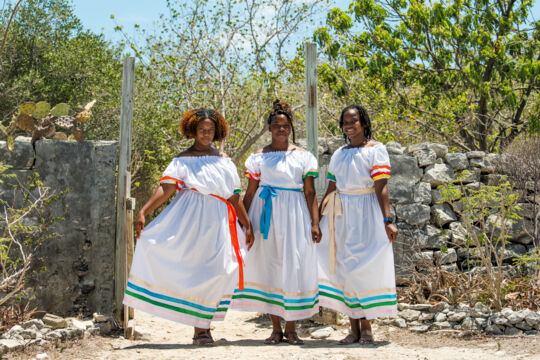
The base of the women’s national costume is a white dress with a hem that falls somewhere between the calf and the ankle. While dresses vary, they typically have a wide elasticized neckline with a folded frill trim layer where the first pattern of colors appears.
The pattern of yellow, red, white, and orange bands is printed on either the neckline or sleeves, and the tan, green, turquoise, and pink bands are located above the hem of the dress.
A headband or headscarf and a colored sash that wraps around the waist of the dress denote where the person is from.
Men’s National Costume
The men’s national costume is a short-sleeved white button-up shirt and a pair of loose-fitting white pants.
The first four colors (yellow, red, white, and orange) are located on the right sleeve and the following color group (tan, green, turquoise, and pink) is located on the left sleeve.
The men’s national dress also includes a straw hat with a fabric band that represents their home island.
Traditional Clothing
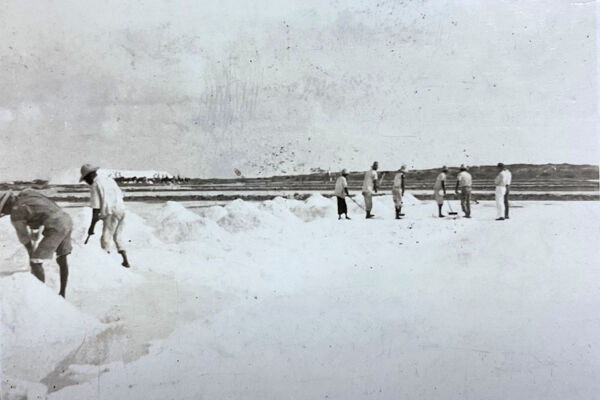
Clothing in the Turks and Caicos Islands has historically been quite simple and evolved based on functionality.
The typical clothing for a salt raker in the late 1800s and early 1900s was a wide-brimmed hat, a long-sleeved shirt, and pants rolled up to the knee. This work was typically done barefoot, which would have been incredibly uncomfortable for laborers.
As is the case with many other warm-weather countries, it was preferable to wear white or light colors, as light-colored clothing reflects sunlight and keeps the wearer cooler. Hats were ubiquitous across most jobs and were worn by men and women to protect from the blazing sun.
A unique local fashion practice was the construction of straw hats. Straw work has been practiced in the islands for hundreds of years and involves the sourcing, cutting, drying, and weaving of local crops like fanner grass and palm leaves to produce hats, woven baskets, bags, and other items.
Straw work was particularly prevalent on the islands of North Caicos and Middle Caicos—these islands, which experience the most rainfall in the country, would have supported a large reservoir of straw work materials for early settlers to work from.