Turks and Caicos Fly Fishing
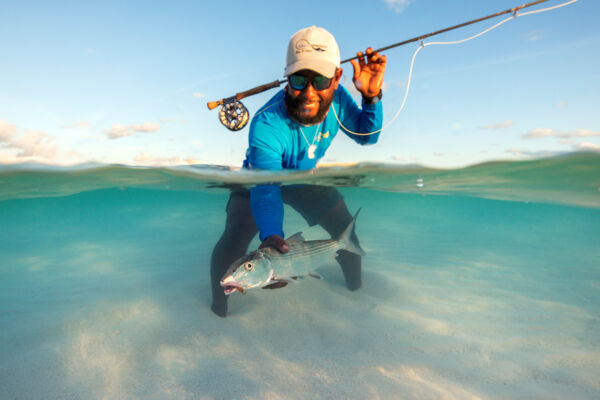
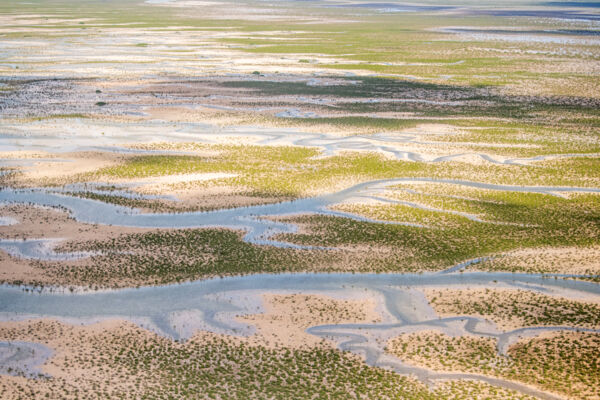
The Turks and Caicos Islands offers exceptional saltwater fly fishing, due to the extensive shallow flats and complex intertidal creeks of the Caicos Banks. Many of the tidal creeks are lined with mangroves, creating the perfect environment for a wide range of marine life.
One of the defining traits of the fly fishing environment in the Turks and Caicos is the clarity of the water. In many situations, anglers will be able to clearly see fish and schools, which can provide fascinating and exciting feedback on casting practices.
The term creek is often used in the country and by anglers, but this usage solely refers to marine intertidal creeks, and not freshwater creeks, of which there are practically none in the islands.
For those wanting to fly fish with a guide, Providenciales, North Caicos, and South Caicos are all good options, with perhaps South Caicos having the easiest access to optimal locations. Those wanting to DIY (do it yourself) fly fish are best served staying on North Caicos or Middle Caicos.
Fly fishing in the Turks and Caicos is typically done by wading, as it’s the best way to approach fish without spooking them, yet it’s also common to fish directly from a flats boat as well. Some anglers fish from paddleboards or kayaks, but most will find that practice to be difficult.
There isn’t a defined season for bonefish, and they can be caught year-round. For tarpon, the spring and summer months tend to be a little better, but it’s not absolute and they can also be found throughout the year.
The Fish
Bonefish, tarpon, permit, barracuda, jacks, and very occasionally snook are the catch in the Turks and Caicos.
There’s no freshwater fly fishing in the country. Redfish, ladyfish, and seatrout are not found in the islands.
Bonefish
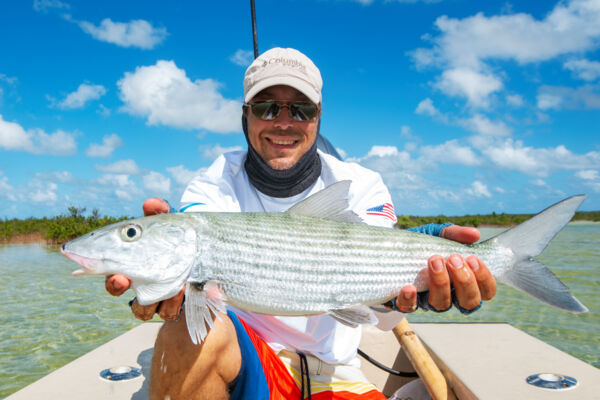
Bonefish is the primary target in the islands. The complex marine intertidal creeks and flats shelter large numbers of this silver fish, which is typically found in schools of widely varying numbers.
In the smaller creeks, bonefish schools are often in the 5-30 member range, yet in the larger open flats, such as Bottle Creek near North Caicos or the northern reaches of Stake Bank near South Caicos and Hog Cay, the schools can have nearly a hundred fish. Although not common, enormous schools that number in the several hundred can occasionally be seen in the more significant channels of the greater Caicos Banks, such as in Ship Channel and Black Rock Channel near Black Rock.
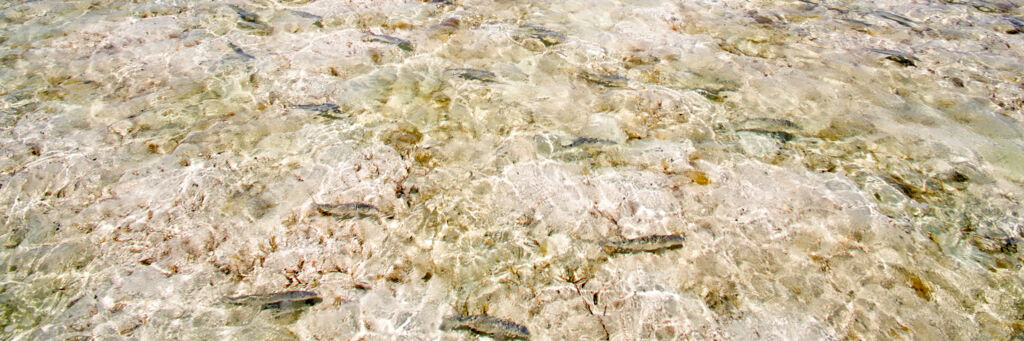
In most situations, anglers should be able to see approaching bonefish, or evidence of feeding bonefish. In the clearer creeks, the fish can simply be seen, along with their wake. When feeding in the more open areas, typically there will be an area of cloudy turbidity as the bonefish are foraging for crabs and shrimp. Such isolated and distinct disturbed areas are a key indicator of bonefish.
Bonefish in the country can exceed 10 pounds in size, but many are in the 4-6 pound (1.8–2.7 kg) range.
Tarpon
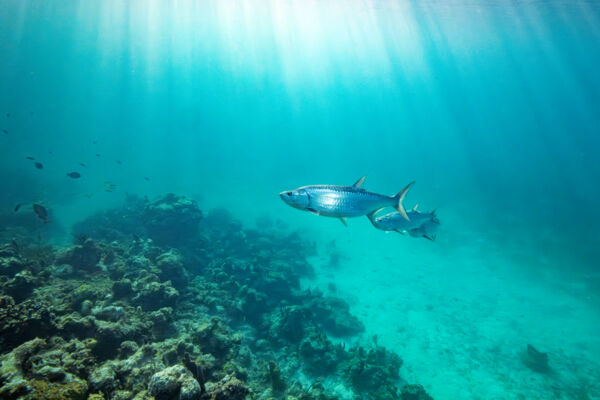
Tarpon are uncommon, yet are typically present throughout the year. Sizes vary widely, and the location of tarpon in the Turks and Caicos can be varied, and frankly, a bit puzzling. Mid to large examples in the 5-60 pound (2.3–27 kg) range can be found in the flats, channels between the islands, and in sheltered bays.
However, juvenile to mid-sized tarpon appear in some of the landlocked marine ponds, some of which are a considerable distance from a coast. These inland ponds may be somewhat tidal, which suggests at least a marginal conduit connection to the ocean, yet it’s unclear how the tarpon end up in the ponds. One such example is the Boiling Hole on South Caicos, where the fish can sometimes be seen inside the man-made structure. Other examples include small and isolated ponds in the interiors of East Caicos and Middle Caicos, or inside the interior pond of the Northwest Point Pond Nature Reserve.
Permit
Permit in the islands is usually found along the sandy transitions between flats and channels, such as around the waterways that separate the small cays in the banks. They often travel in very small schools of small numbers.
Barracuda
Barracuda is common throughout all marine waters of the country, including the shallows and creeks. Although barracuda typically doesn't enjoy the same recognition as bonefish or tarpon, these predatory fish typically respond aggressively to lures, and often put up significant fights. In the shallows, most barracudas will be on the smaller end of their size scale, yet large examples are definitely a possibility. In the channel exchanges between cays and islands where the flats join the bays and open ocean, very large examples may definitely be present.
Jacks
Jacks, primarily including horse-eye jacks and bar jacks, are often found in the deeper channels between cays and in the interchanges between flats and deeper water. The horse-eye jacks can be surprisingly large, exceeding 20 pounds (9 kg), and can put up a considerable fight.
Snook
Snook can be caught in the Turks and Caicos, yet is definitely not a reliable sighting and there should be no expectation of catching one. The presence of snook is usually associated with atypical weather, such as tropical storms or hurricanes in the region.
Fly Fishing Guides
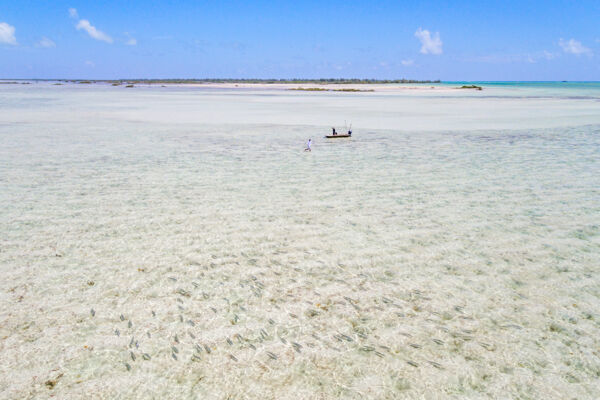
The Turks and Caicos has a small yet select number of professional flats fishing guides, most of whom have spent decades learning the difficult shallows and complex tides of the Caicos Banks. The skills and knowledge required to be a proficient guide in the islands go well beyond having good casting skills. Many of the best locations for bonefish in the country are not easy to access due to depths that are often well under 2 feet, and significant tide lags and water stacking caused by onshore wind make navigation and access to the great spots even more difficult to understand.
Fly fishing is a more exclusive sport than other types of fishing due to the casting skills it requires, and the consequent limited number of guides in the islands typically do it for the love of the sport. Because of this, there isn’t quite the variance in charter and experience quality between guides that can be found with other activities in the country.
The Fly Fishing Association
The Turks and Caicos Fly Fishing Association (TCFFA) launched in 2024, and has the goals of certifying guides and advocating for the industry. Many of the established guides are involved in the organization.
Charter Prices
Rates start at about $600 for a half-day on one of the smaller boats, and can be $1,800–$2,200 for a full day on the larger vessels. Airboats can carry an additional cost premium.
The Vessels
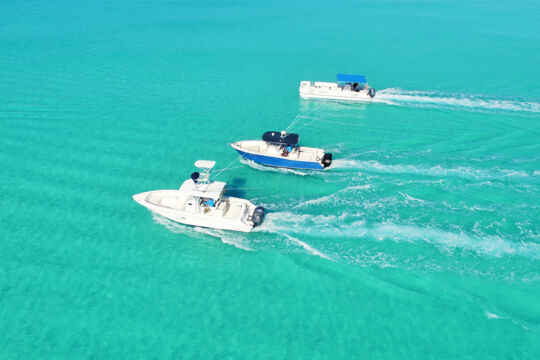
Mid-sized flats boats by Egret, Hewes, or Maverick, typically in the 16-21 foot (4.9-6.4 meters) range, are the norm for charters. These boats are usually comfortable for 2 passengers, but can take up to about 4 in addition to the captain. When close to potential fishing locations, or when a school of fish is spotted, boats are often poled in by the guide in order to avoid noise from the engine.
There’s no shade on the vessels used for bonefishing, so it’s important to be prepared for intense sun. A hat, buff, long sleeves, gloves, and polarized sunglasses are advisable.
Instruction
Interested in learning to fly fish? Fly fishing is notoriously difficult to master, but local guides are happy to provide full instruction, or simply give pointers when out in the field. There are no local guides or schools dedicated to teaching beginners. All guides will usually be happy to work with all skill levels.
Equipment
Rods
Guides will typically provide rods for their guests' use. For those who wish to use their own, a 9’ 7-9 weight rod is usually the best choice, along with 9-12’ of fluorocarbon leader and 200 yards of backing. A 10-11 weight is best if targeting larger tarpon or barracuda. Reels should be corrosion-resistant due to the salty environment, and have smooth drag.
Spinning rods can also be used to catch bonefish and other game fish, yet the heavier lures that’ll typically be needed for casting distance with a spinning rod are much more likely to spook the bonefish versus a lightweight fly.
Flies
The primary diet of bonefish in the islands is small crabs, shrimp, worms, and shellfish. Flies that mimic crabs, shrimp, and minnows often do well. Classic flies such as the Crazy Charlie and Gotcha are good choices. For barracuda and jacks, many types of lures work well, including spoons and soft-body lures.
There is currently no fly-tying industry in the Turks and Caicos, yet there are ongoing efforts to jump-start it, primarily in the traditional weaving community, which is largely based on the islands of North Caicos and Middle Caicos.
Attire and Other Accessories
Water temperature in the islands is warm, and the flats and shallows are typically a bit higher than the surrounding ocean. Waders are not a common sight.
The Turks and Caicos often experiences a 10-20kt breeze (12-23 mph, 19-37 kph) from the east or southeast, which can create a bit of chop on the banks, so it’s best to be prepared. Sensitive equipment such as phones or camera gear should be in a dry bag or waterproof case. Boats will usually have a sealed storage hatch, but the redundancy is a good practice. There can be spray that hits passengers from the chop, especially when running upwind, so plan attire accordingly.
Anglers are typically knowledgeable on the subject, but it’s important to clarify the importance of good polarized sunglasses. Tint preference, of course, varies, yet strong polarization is essential.Locations
Providenciales
Nearly all overnight visitors to the country stay on the island of Providenciales, and consequently the largest number of fly fishing guides are based on the island. Charters will typically head directly from Providenciales to at least North Caicos, but may visit sites as far as East Caicos, especially on full-day charters with good weather. Transit times range from about 10 minutes for spots near Water Cay and Pine Cay, to 30 minutes for North Caicos, and 1-2 hours for Middle Caicos and East Caicos.
There are many potential DIY fly fishing locations on the island, including Juba Sound and Flamingo Lake off of Venetian Road in the Turtle Tail area. However, these are some of the harder-hit spots in the country, and don’t really compare well to the more remote areas.
North and Middle Caicos
These two central islands offer both a limited yet select group of guides and what is typically the best array of locations accessible by road for DIY anglers. Bottle Creek Lagoon and the extensive tidal creek that separates the two islands, as well as the greater Ramsar Nature Reserve area, are the areas usually visited by guides from the two islands. Transit times to potential fishing spots start at about 10 minutes.
Those practicing DIY fishing by road should be aware that some of the ponds accessible from the road, even those appearing to have marine water, are landlocked and do not have game fish. The region adjacent to the North and Middle Caicos Causeway, especially on the southern Middle Caicos side, is one of the better locations accessible by road.
Water clarity, comparatively, is poorer on the western North Caicos side of the banks, and gradually improves to the east towards Middle Caicos and East Caicos. To the east of Vine Point and the Middle Caicos Ocean Hole, clarity is often quite good. Likewise, the farther into the intertidal creeks, regardless of island, the better the clarity.
South Caicos
South Caicos is located near East Caicos and Hog Cay, which are extensive uninhabited islands that are surrounded by shallows and mangrove wetlands, which are perhaps the best fly fishing locations in the country. The extensive and very shallow Stake Bank located to the north of South Caicos can make access difficult for traditional flats boats and skiffs, and consequently some of the guides on South Caicos have adapted to using airboats. However, many fly fishing guides in the islands believe that the noise from airboats has had a strong impact on populations and behavior, and are encouraging the government to take action. Transit times range from 15 to 60 minutes.
Between South Caicos and East Caicos are a number of small cays interspersed between relatively deep channels, including Plandon Cay, Middle Creek Cay, and McCartney Cay, and to the west of these cays is an expanse of shallows. This is the best area for those wanting to fish via kayak or paddleboard from South Caicos. Jerry Camp is the most convenient launch point. A full range of the fish typically targeted by those fly fishing can potentially be found in this greater area. The deeper sections of the channels have a relatively high concentration of predators, including sharks and some very large barracudas.
Grand Turk and Salt Cay
Grand Turk and Salt Cay do not have the extensive marine flats and wetlands that the Caicos Islands do, so fly fishing is far more limited. Both islands do have some shallows, so there is the possibility of tarpon or bonefish, and of course the likely chance of barracuda.
DIY Fly Fishing
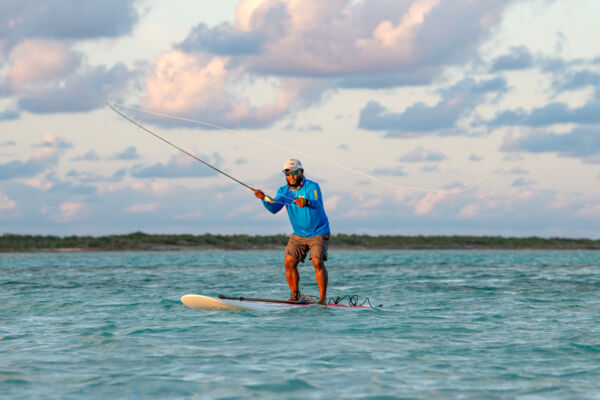
The Turks and Caicos definitely offers opportunities for DIY fishing, especially for those staying on North Caicos and Middle Caicos.
Legally, any vessel used for fishing or that is transporting fishing gear, which includes kayaks, paddleboards, and jet skis, must be registered for fishing. This process unfortunately isn’t viable for short-term visitors. Enforcement, however, is often lax in the case of small paddled vessels, especially around the islands other than Providenciales.
Those DIY fishing are responsible for obtaining their own licenses, and knowing and avoiding the areas where fishing is prohibited, which include national parks and nature reserves.
Those wanting to fly fish for bonefish on their own are perhaps best served by staying on North Caicos or Middle Caicos (both islands are connected by a road causeway), having a rental vehicle, and driving around the two islands exploring the many spots. Nearly all of the flats and shallows that are accessible by land on the two islands are not within protected areas, though there are a few exceptions.
The island of Providenciales has a decent selection of basic fishing equipment available for sale, yet limited options for fly fishing equipment. There isn’t much other than bait, hooks, and lead weights for bottom fishing available on the other islands in the country. There are very limited rod rental options for DIY fishing. Some guides are willing to do so depending on demand, but there’s no reliable availability.
Regulations and Licenses
All visitors 16 years or older, as well as most residents, must be in possession of a valid fishing license when fishing in the Turks and Caicos. For visitors, daily and monthly licenses are available, and may be purchased at many of the marinas in the country. In the case of charters, licenses will often be obtained by the guide for their guests.
It’s important that DIY anglers be aware of and not fish in protected areas, which include national parks and nature reserves. Enforcement of fishing regulations in the Turks and Caicos is, however, selective and often lax. The likelihood of enforcement will often depend on where you are, and who you are. Visitors fishing in a protected area on or near Providenciales may attract enforcement. Outside of the general Providenciales area, the chance of enforcement diminishes greatly. Most guides in the Turks and Caicos regularly fish (often practicing catch and release) inside the Ramsar Nature Reserve, which is located on the remote southern coasts of North Caicos, Middle Caicos, and East Caicos. Fishing in this nature reserve is legally largely prohibited (excepting in some situations the spearing of invasive lionfish, or catching fish for scientific purposes), yet enforcement in this area is an anomaly.