Providenciales Wakesurfing
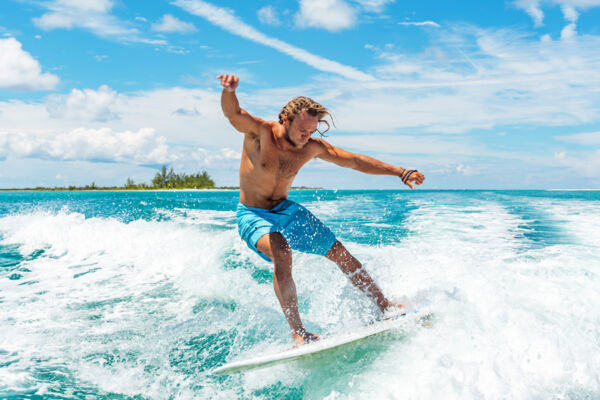
Wakesurfing , where surfers ride a wave that is produced by a boat, is a very popular water sport in the Turks and Caicos. It’s not just spouting overused superlatives to say that the Turks and Caicos is an incredible destination for the activity. Conditions are of course not always perfect, but the turquoise water can’t truly be appreciated by simply looking at photos and videos.
It’s not just the clear water and sandy shallows. Wildlife encounters, such as when one of the local Atlantic bottlenose dolphins join the surf session, do happen and are unforgettable. Wake to Wake, a local water sports company that produces some exceptional video and photo content, has many remarkable videos of dolphins riding with surfers.
On most full-day charters, it’s common to visit some of the beaches, cays, and sights around the island, and not simply spend all day surfing, so the experience is also a boat tour.
Wakesurfing versus Wakeboarding
A direct counterpart to wakesurfing is wakeboarding. The primary difference is that wakeboarders are towed via a line continually, versus wakesurfing, where surfers are riding a wave produced by the boat without being pulled. Many boats can be adapted to do some wakeboarding, but only specialized wake boats are able to produce a nice wave as they have internal tanks that can be filled with sea water in order to increase the boat’s displacement. Wake boats also have inboard engines and platforms on the stern, so they are much safer and easier for wake sports than boats with outboard engines are. The local wake surf companies equip their boats for both sports.
Wakesurfing is far less strenuous and a more physically forgiving sport than wakeboarding. They may appear to be similar, but the effort required to hang onto the tow line and respond to waves and chop when wakeboarding is much greater than what it takes to simply surf, which is rather largely a combination of balance and board skills.
Locations
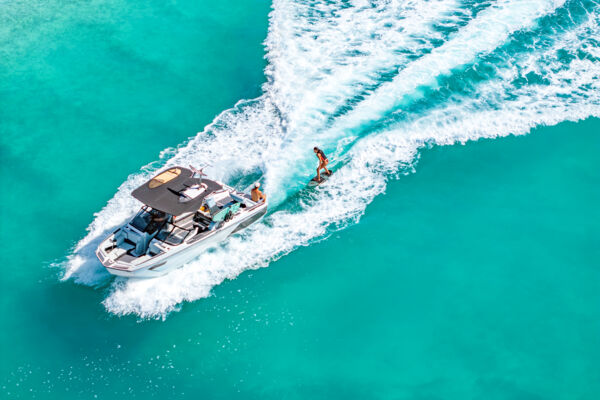
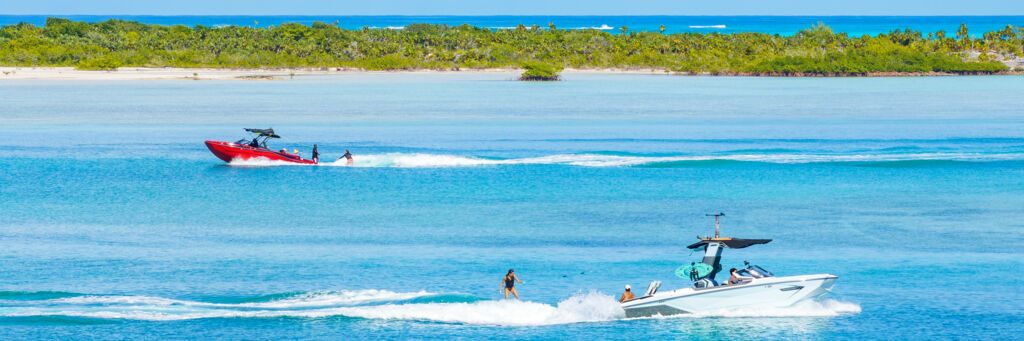
Flat water is ideal for wakesurfing, so excepting the calmest of days, sheltered locations are sought out. The Turks and Caicos typically experiences an eastern or southeastern breeze, so near Providenciales, good locations are usually Stubb’s Creek (the channel between Mangrove Cay and Donna Cay), the channel between Donna Cay and Half Moon Bay, and the long coastline along the northwest of Half Moon Bay, Water Cay, and Pine Cay.
If the wind speeds are very low (below about 8-10kts), there’s typically not a need to seek out a sheltered spot, and the open water of Grace Bay and the broader Caicos Banks are viable, and allow for surfing in some beautiful locations.
Prices and Charters
Wake boat rental tends to be more expensive than other boat charters, and starts at $400-500 per hour for shorter duration trips, and up to about $4,000 for a day on the larger boats. Wake boats can accommodate 6-12 guests in addition to the crew. Refreshments are typically included.
Learning to Wakesurf
All of the wake sports operators in the Turks and Caicos are happy to work with beginners.
Wakesurfing is definitely more challenging to pick up than many other water sports. It’s not quite as difficult as conventional wave surfing or kiteboarding, but be patient, as most will need 4-10 sessions before being able to surf for more than a brief moment. It can be a bit tedious to start, as beginners start with a short tow rope off the stern of the boat, and then once they catch a wave the rope is dropped. As may be expected, falling off the surfboard is constant for beginners, and the boat has to stop for the surfer to reset and grab the line after every crash.
Those who have experience with other board sports, such as snowboarding or kiteboarding, will definitely have an accelerated skill progression and may be able to actually start surfing for more than a few seconds in the first session.
Wakesurfing is suitable for most ages. Participants wear a life jacket, and strong swimming skills are not necessary.
Slight variations in board size and design can have a big effect on ease of surfing for a respective surfer, and instructors will try to match the surfer with the right board.