Turks and Caicos Geology, Ecology & Climate
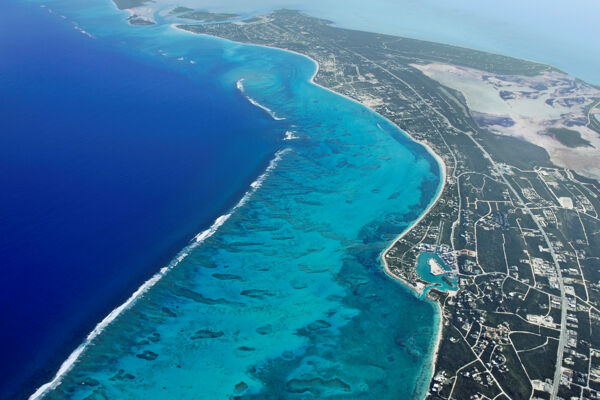
The Turks and Caicos Islands are found south of the Bahamas island chain, and are situated on an underwater plateau marine bank that rises about 13,000 feet (3,962 m) up from the surrounding Atlantic Ocean sea floor. This plateau is split by the 6,000-foot-deep (1,828 m) and 20-mile-wide (32 km) Turks Island Passage, which separates the small Turks Islands of Grand Turk and Salt Cay from the Caicos Islands archipelago and the extensive Caicos Banks.
Water depth over the majority of the Caicos Banks is quite shallow. If ocean levels were 50 feet (15 m) lower than they are currently, the Caicos Islands would form a single land mass larger than Puerto Rico.
Except for a few tiny sandbar cays, the islands in the Turks and Caicos have a soft limestone foundation. Land elevations tend to be quite low, with the highest points in the country being Blue Mountain on Providenciales and Flamingo Hill on East Caicos, each of which have a height of approximately 156 feet (48 m).
Due to the limestone origins of these islands, the graded and bulldozed land and roads are usually a brilliant white. These areas often create a large quantity of fine dust as the exposed soft stone continues to decompose in the elements.
The land mass in the Turks and Caicos is limited and, for the most part, coastal. In fact, the furthest that one can venture inland from a coast or tidal wetland is about 2 miles (3.2 km) at Kew on North Caicos.
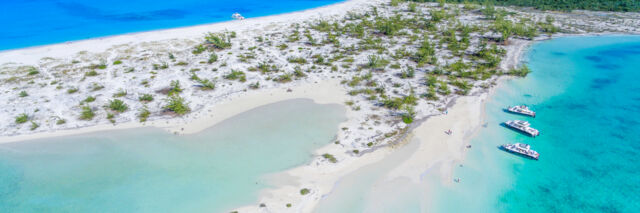
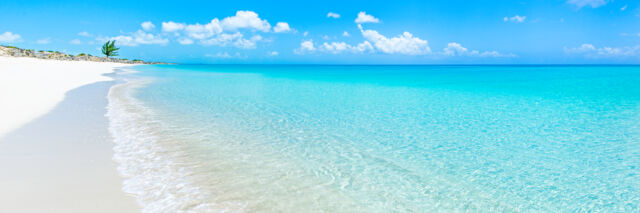
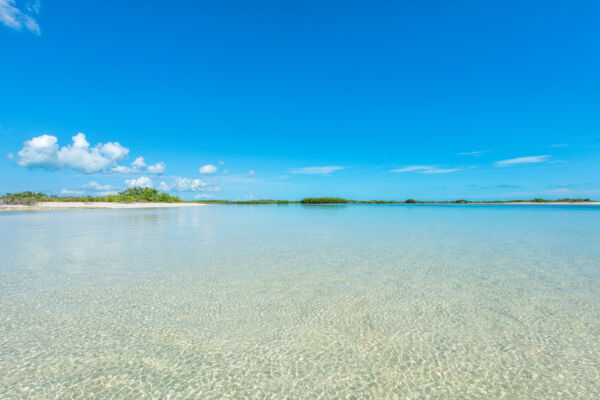
The beautiful beaches in the Turks and Caicos are primarily composed of broken-down shells and coral. This composition, along with the fact that very little hard stone exists in the country to form gravel, results in the brilliant and soft white beaches.
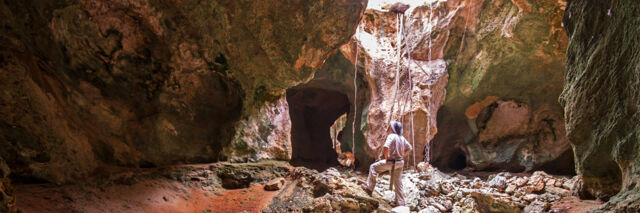
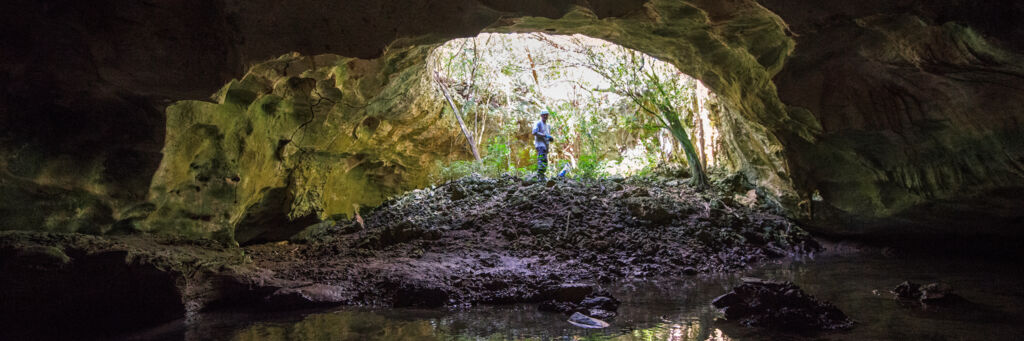
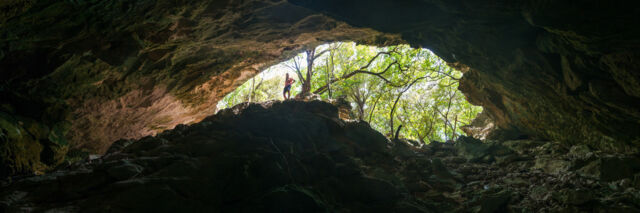
The karst process of dissolution has definitely left its mark on the islands, and dry and underwater caves and sinkholes created by this action are common across the Caicos Islands. Usually exhibiting as shallow and small-diameter circular sinkholes in the bedrock, these formations were created over a long period of time as slightly acidic rainwater would gather and dissolve the soft limestone as it drained to the water table. Recognized examples of features formed by the karst process include The Hole on Providenciales, Cottage Pond on North Caicos, The Boiling Hole on South Caicos, and Indian Cave and Conch Bar Caves on Middle Caicos.
Ecology
Vegetation tends to be of low height throughout the Turks and Caicos. Large trees are not very common and tend to be found in one of two terrain types. On some sandy coastlines, the non-native casuarina (also called the Australian Pine and locally known as the she-oak, and not to be confused with the indigenous Caicos pine) can be seen lining the beach and commonly reaches heights of about 40 feet (12 m). Further inland, forests of mixed native hardwood and softwood trees can be found but these usually don’t exceed 30 feet (9 m) in height.
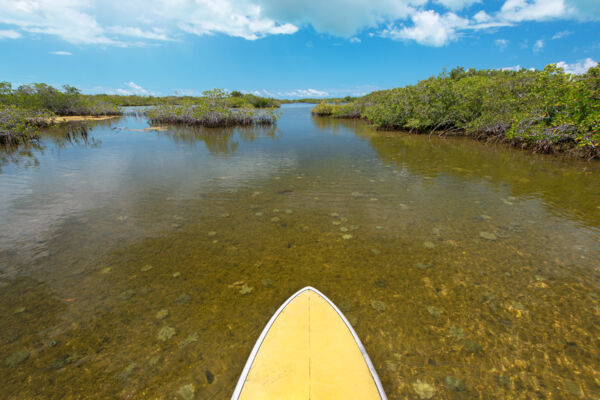
Mangrove wetlands can be found on all main islands in the country, and are extensive on the south sides of North and Middle Caicos. The shallow channels and waterways here are a nursery for sharks, turtles, rays, conchs, and fish, and are amazing to explore by kayak or paddleboard.
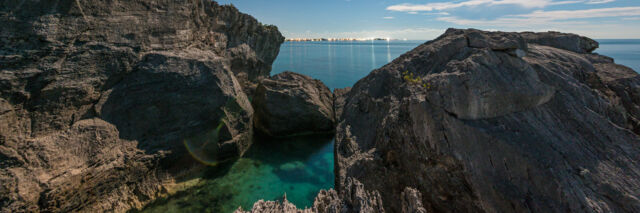
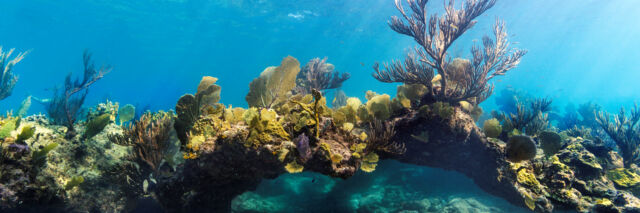
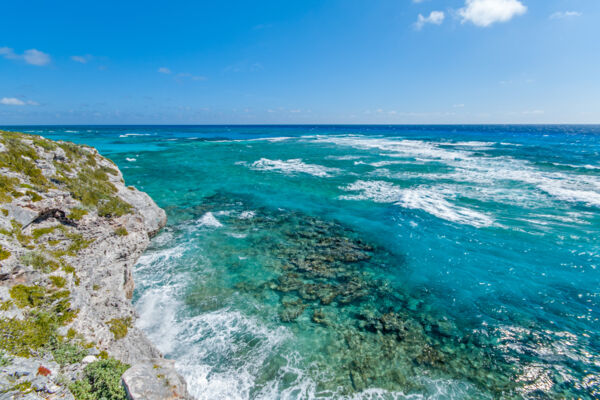
Underwater, the Turks and Caicos has vibrant coral and sea life. All of the main islands in the country are located next to the edges of either the underwater Turks Islands plateau or the Caicos Islands plateau. The edges of these plateaus are typically abrupt, making for excellent wall diving sites. There are concerns that the waters are being overfished, and declining conch and lobster populations definitely appear to back this up.
Several native land animals are found here. The most famous is of course the Turks and Caicos Rock Iguana, yet several smaller reptiles also make their home here including small lizards, anoles, geckos, snakes, and skinks.
Evidence suggests that several larger and fascinating land animals likely lived in the islands before the arrival of humans, which is thought to have occurred around the year 700 AD. Bone remains from large tortoises, giant iguanas, and possibly crocodiles were recovered during archaeological digs conducted at cave sites in the country. These land animals were probably hunted to extinction by the Taino aborigines.
Weather and Climate
The Turks and Caicos Islands experience very little rainfall, and most of what does occur usually happens at two to three single times during the year, resulting in flooding. Consequently, much of the plant life is either drought resistant, or is able to survive in very salty marine wetland environments.
Diseases and Dangerous Animals
The Turks and Caicos is fortunate in that there are no serious natural threats. There are no poisonous snakes (only two types of dwarf boas, and a very tiny blind snake are extant here) and the worst insects one is likely to encounter are paper wasps. The extremely rare black widow and brown recluse spiders have been known to be seen here, yet there are no recorded cases of local bites.
There are no endemic tropical diseases.
As is increasingly becoming the case in the Caribbean and warmer Atlantic waters, lionfish can be found here. An invasive predatory species from the Indo-Pacific, these spectacular looking fish have venomous spines on their back and are capable of giving very painful stings. Although extremely uncommon, in the worst-case scenarios these stings can cause temporary seizures or paralysis. Fortunately, lionfish are not aggressive to humans and only sting in defensive situations.
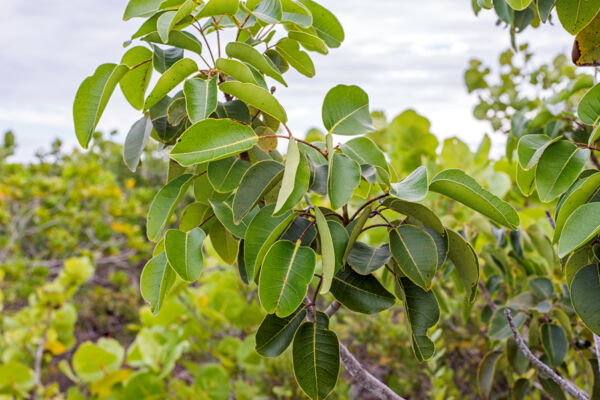
There are two common types of poisonous trees that can cause rashes if touched: coral sumac and the manchineel. Both have a similar appearance and are generally found in coastal areas such as Chalk Sound National Park and in the vicinity of the Crossing Place Trail. Although not life-threatening, these trees should be recognized and avoided if venturing off of the beaten path. Manchineel is less common than coral sumac, yet manchineel does produce small poisonous fruits. Do not touch, pick, or eat the fruits. Unlike some other tropical destinations, the Turks and Caicos do not have any wild tasty produce to pick. Much of the “fruit” found growing won’t kill you, but saying that they are an acquired taste would be an understatement.